






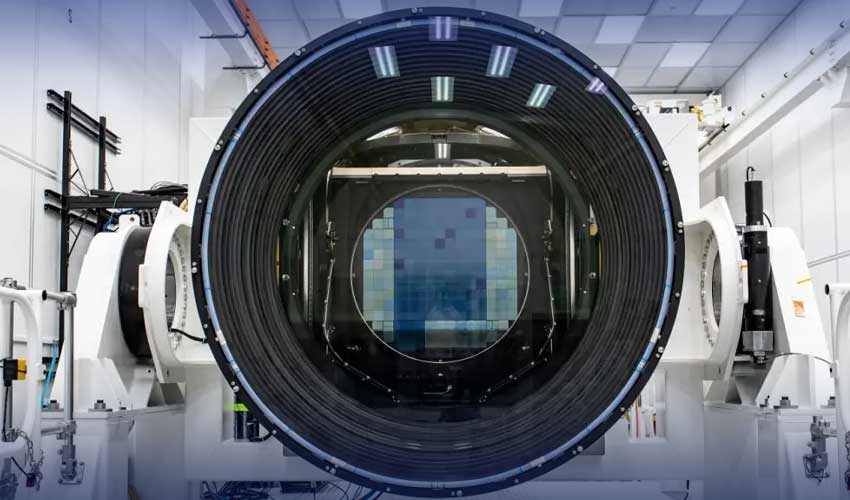
Engineers and scientists at the SLAC National Accelerator Laboratory, in collaboration with other institutions, have developed the groundbreaking 3,200-megapixel Legacy Survey of Space and Time (LSST) Camera. This innovative camera, renowned for its unprecedented detail of the southern night sky, has the potential to revolutionize our understanding of the universe.
Over a span of ten years, the LSST Camera will amass a vast amount of data, offering researchers a treasure trove of information to analyze. This data holds the promise of unveiling the mysteries of dark matter, a substantial but enigmatic component of the cosmos, as well as dark energy, the force propelling the universe’s rapid expansion.
The integration of this unique camera with the Rubin Observatory systems in Chile marks the commencement of what Director of Rubin Observatory Construction and University of Washington professor Željko Ivezić describes as “the greatest movie of all time” and “the most informative map of the night sky ever assembled.”
Renowned physicist Turner underscores the significance of delving deeper into the cosmos, emphasizing the LSST Camera’s pivotal role in advancing our understanding of fundamental physics.
The LSST Camera itself is a marvel of engineering, comparable in size to a small vehicle and weighing over 3,000 kg. Its front lens, measuring more than five feet in diameter, sets a new record. A meticulously crafted three-foot-wide lens is employed to maintain optical integrity and seal the vacuum chamber housing the camera’s expansive focal plane.
Comprising 201 specially designed CCD sensors, the focus plane is astonishingly flat, with variations no wider than a tenth of a human hair. The precision extends to the pixels, which are a mere 10 microns wide, showcasing the remarkable technological prowess behind this groundbreaking instrument.
Once operational, the primary objective of the LSST Camera is to meticulously map the positions and luminosities of diverse celestial objects strewn across the night sky. Notably, it will actively search for faint signals of weak gravitational lensing, shedding light on the elusive dark energy by elucidating the distribution of mass throughout the universe and its evolution over time.
Through the identification of dark matter clusters and the detection of supernovae, scientists aim to scrutinize the evolving distribution of galaxies, essential for advancing our understanding of dark energy and dark matter.


